The short answer
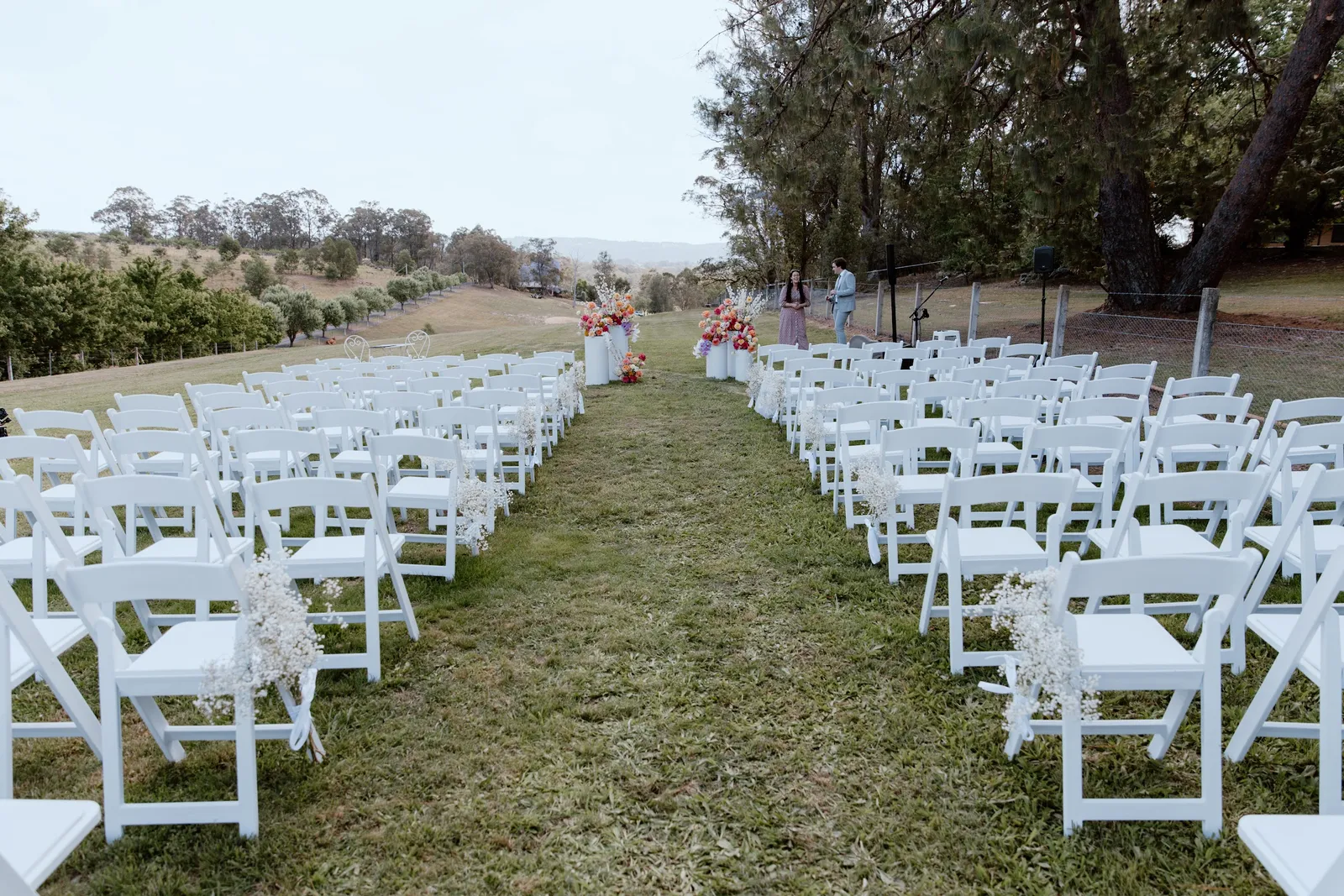
A backyard, farm or marquee wedding means building a temporary venue from scratch. Beyond the marquee itself, budget for power, toilets, water, lighting, flooring, bins, guest transport and a wet-weather plan, and expect hire companies to bump in the day before and bump out the day after. The biggest hidden cost is labour: without a plan, family members end up running the day.
At a glance
- The marquee is only the start. Power, toilets, lighting, flooring and bins are where the budget grows.
- In NSW, a marquee for a private function can be exempt development if it meets the state standards. If it doesn't, you need council approval (checked October 2026).
- One food truck rarely serves 100 guests quickly. Plan for more trucks, a short menu or a staggered service.
- Rural properties often have little parking and gravel paths. A shuttle or bus solves both.
- Most hire companies bump in the day before and bump out the day after, so the wedding is really three days.
- A day-of coordinator at a property wedding usually needs 10 hours, because setup and pack-down add time on both ends.
Do you need council approval for a marquee wedding in NSW?
Not always. Under NSW planning rules, a tent or marquee for a private function can be exempt development if it meets set standards. If it doesn't meet them, you need approval first, so check with your council.
At the time of writing (October 2026), the NSW Planning Portal lists tents and marquees for private functions as temporary structures that can be exempt development under the state's Exempt and Complying Development Codes. The structure must meet the development standards, including written consent from the landowner, not blocking parking or access, firm and level ground, and resisting loads under the relevant Australian Standards. The policy also sets size and other limits, and some land is excluded.
Ask your hire company whether their marquee meets these standards on your site. If it's large, or the property is heritage-listed, call the council before you pay a deposit.
Wind, rain and the ground under your feet
- Sides: order them even if you plan to leave them rolled up. Wind and rain change direction in the evening.
- Flooring: a dance floor on grass sinks and tilts. Flooring also keeps heels out of the mud.
- Weather call: agree with the hire company when they will make a wind or storm decision, and who you call on the day.
How much power, water and lighting does a property wedding need?
Enough for every supplier running at once, after dark. Ask each supplier for their power needs in writing, and plan lighting for paths and toilets as well as the marquee.
Power is the most common surprise. A house circuit usually can't run catering equipment, a DJ and festoon lights together, and one tripped switch can stop dinner. Collect each supplier's power needs and give the list to the generator company to size. Ask where the generator will sit, because they are loud and need fuel for the whole night.
Water matters for the caterer, the bar and hand washing near the toilets. Check where the taps are, whether the property runs on tank water, and how far hoses need to reach.
Lighting is easy to underestimate because you visit in daylight. A farm at night is properly dark. Guests need a lit path from the marquee to the toilets, the car park and the bus pick-up.
How many toilets and bins does a backyard wedding need?
More than you think, especially if drinks are flowing. Council event guides scale toilets to crowd size and increase them when alcohol is served. Your hire company can size it for your numbers.
A house bathroom won't cope with 100 guests over six hours. NSW council guides for public events give a sense of scale. Wollongong City Council's event guidance, checked in October 2026, suggests 5 female toilets, 2 male toilets, 5 urinals and an accessible toilet for a liquor-licensed event of up to 500 people, with fewer where no alcohol is served. A private wedding isn't a public event, but it shows how quickly the numbers climb.
- Include at least one accessible toilet for older guests and anyone with mobility needs.
- Ask about hand washing, lighting and servicing, and place toilets on firm, level ground with a lit path.
- Order bins for general waste and recycling, and decide who takes the rubbish away. Caterers often remove their own waste, but ask.
What does your caterer need at a backyard or farm wedding?
A working space close to the marquee, with power, water, lighting and cover. Ask your caterer for their site requirements before you lock in the layout.
Most caterers bring their own equipment, but they still need somewhere to work: usually a prep tent behind the marquee, flat ground, power, water, bins and a way to get the van close. Put their needs on the site plan first, then fit the styling around them.
Questions for your caterer
- Do you need a prep tent, and do you supply it or do we hire it?
- How much power do you need, and at what times?
- Do you need running water, and how close does your vehicle need to park?
- What crockery, cutlery and glassware are included?
- Do you take your rubbish with you?
Can a wedding food truck feed 100 guests?
Usually not quickly. One truck cooking to order can leave guests waiting a long time. For 100 guests, plan for more than one truck, a short menu or a staggered service.
A wedding food truck suits a backyard wedding, and it can work well. The catch is speed. Many trucks are built for a steady line of customers, not 100 people who all want dinner at 6:30pm. Couples report that some trucks can't serve that many at once, and guests can wait an hour or more.
- Ask how many meals they serve per hour, and do the maths for your guest count.
- Book two or more trucks for larger weddings, or pair a truck with a grazing table or canapés.
- Keep the menu short so each order is quick.
- Stagger service by calling tables up in turns, so the line never gets long.
- Check access: trucks need firm, level ground, a route in that won't bog, and either their own generator or a power supply.
How do guests get to and from a rural property?
Ideally by shuttle or bus. Rural properties rarely have enough parking, the paths are often gravel or grass, and guests shouldn't be driving home on dark country roads.
Parking comes up in a lot of enquiries. A South Coast charter bus operator summed it up in a wedding forum: wineries, beach estates and rural properties often have tiny parking, and guests end up walking in heels on gravel. On a private farm, the car park is a paddock.
- Book a shuttle or bus from a town centre or accommodation, with a set last pick-up time.
- If guests do drive, mark out the parking area and light it. Ask a friend to direct cars as they arrive.
- Keep a clear lane for suppliers, the caterer and emergency vehicles.
If you're marrying in a regional area, see my notes on the South Coast, Southern Highlands and Hunter Valley.
What about neighbours, noise, drinks and insurance?
Tell the neighbours early, plan the music around NSW noise rules, keep drinks free if you don't want a liquor licence, and talk to your insurer before the day.
Noise. At the time of writing (October 2026), NSW EPA guidance says amplified music from residential premises shouldn't be heard inside a neighbour's home after midnight on a Friday, Saturday or the night before a public holiday, or after 10pm on other nights. Councils and police can still act on offensive noise at any time. A friendly note to the neighbours a few weeks out, with the date and finish time, goes a long way.
Drinks. NSW Government guidance says a liquor licence is not required when there is no direct or indirect charge for the drinks. If drinks are sold, or included in a ticket or package, a licence is needed. RSA rules don't formally apply to free drinks at an unlicensed private event, but following them is strongly recommended. Friends running the bar is a common plan. Make sure someone sober is in charge of it.
Insurance. Ask your home insurer whether a large private event is covered or needs extra cover, and ask every supplier for their public liability certificate.
When do hire companies set up and pack down?
Usually the day before and the day after. A marquee wedding is a three-day job, so someone needs to be at the property for every delivery and collection.
| When | What usually happens | Who needs to be there |
|---|---|---|
| 2 to 4 weeks before | Site visit with the marquee company; layout, power and toilet positions agreed | Couple or family, plus the coordinator if possible |
| 1 to 2 days before | Marquee, flooring and sides installed | Someone from the family to meet the crew and sign off |
| Day before | Furniture, lighting, generator and toilets delivered; styling starts if time allows | A named person with the site plan |
| Wedding morning | Florist, caterer, bar and styling set up; final checks | Coordinator, arriving earlier than at a standard venue |
| Wedding night | Personal items, gifts and leftovers packed; hired items stacked for collection | Coordinator and named helpers |
| Day after | Hire company collects furniture, toilets and the generator; marquee pulled down | Someone from the family to let crews in and check the site |
Times vary by hire company and season. Confirm every delivery and collection window in writing, and put them all in one schedule.
Pack-down on the night is the part couples forget. Hire companies often want items stacked and counted for collection, and if nobody owns that job it falls to whoever is still standing at midnight. Pack-down support is available as an add-on.
Who runs the day when the venue is a family home?
Without a coordinator, usually the family. At a venue, a team handles suppliers, timing and pack-down. At a family property, those jobs fall to the hosts unless someone else is named.
At a property wedding, whoever owns the house becomes the venue manager. They take the hire company's calls, find the spare extension cord and decide where the food truck parks, while trying to enjoy the wedding.
"At a backyard wedding the family always ends up working. My job is to make sure Mum and Dad get to be guests, which means I'm the one who knows when the hire truck comes back, where the power runs and who's packing what at the end of the night."
 Sara WardFounder & Lead Wedding Day Coordinator, Hello Love
I start with a consultation 6 to 8 weeks before, then build the run sheet and confirm suppliers 4 to 6 weeks out. The walkthrough 2 to 4 weeks before matters most at a property, because we check power, toilets and parking on the ground. On the day I arrive earlier than the usual 2 to 3 hours before the ceremony, to meet deliveries and oversee setup.
Frequently asked questions
How we researched this
Written by Sara Ward from coordinating weddings at farms, marquees and private properties across NSW, and from the questions couples raise most in their enquiries. Planning, noise and liquor rules were checked on NSW Government and council websites on 7 October 2026; rules change and some land has extra restrictions, so confirm with your council. Hire costs and food truck wait times are reported by couples in Australian wedding forums and are anecdotal. We haven't named hire companies or other suppliers.
- Temporary uses and structures (exempt development) · NSW Planning Portal · checked 7 Oct 2026
- Preventing neighbourhood noise · NSW Environment Protection Authority · checked 7 Oct 2026
- When a liquor licence isn't required · NSW Government (Liquor & Gaming NSW) · checked 7 Oct 2026
- Event planning: toilets · Wollongong City Council · checked 7 Oct 2026
About the author
Founder & Lead Wedding Day Coordinator, Hello Love
Sara Ward is the founder and lead coordinator at Hello Love, a Sydney-based wedding day coordination service. She has spent years running weddings across the Sydney CBD, Inner West, Northern Beaches, Southern Highlands and South Coast - from intimate harbourside ceremonies to 200+ guest receptions.
Related reading
- DIY and Dry-Hire Wedding Venues: What You Need to Organise Yourself
- 6, 8 or 10 Hours: How Much Wedding Day Coordination Do You Need?
- Sample Wedding Day Timeline: A Schedule for Every Ceremony Time
- Wedding Day Emergency Kit: The Checklist a Coordinator Actually Packs
- Wedding day coordination packages & pricing
Want your wedding day handled?
Day-of coordination from $1,800, so you can be present while every detail is managed.